Commercial Rooftop Unit (RTU) Replacement for Facility Managers
A rooftop unit, or RTU, is a packaged heating and cooling unit on the roof that serves retail stores, offices, light industrial space and many multi-unit buildings. Replacement means lifting the old unit off, setting a new one on the curb and reconnecting the gas, power, ducts and controls.
Describe the job and add your city. Free to request, no obligation.
Planned replacement before a failure lets you choose the equipment, the timing and the crane date. When a unit dies in July or January, tenants notice quickly, and the choice is often whatever is in stock. For buildings with several rooftop units of similar age, a staged plan spreads the cost over a few budget cycles.
The details that drive cost and downtime are tonnage, economizer and ventilation requirements, whether the existing curb fits, crane size and access, and the shutdown window. A good scope names each of these.
What the work includes
- A roof survey with unit nameplates, curbs and utility connections
- Tonnage and ventilation review against current needs
- Curb adapter or new curb, with the roof flashing details
- Crane lift planning, street access and permits
- Gas, electrical and condensate connections
- Thermostat or building controls integration
- Startup, airflow check and economizer test
- Optional recurring service for filters, belts, coils and seasonal startups
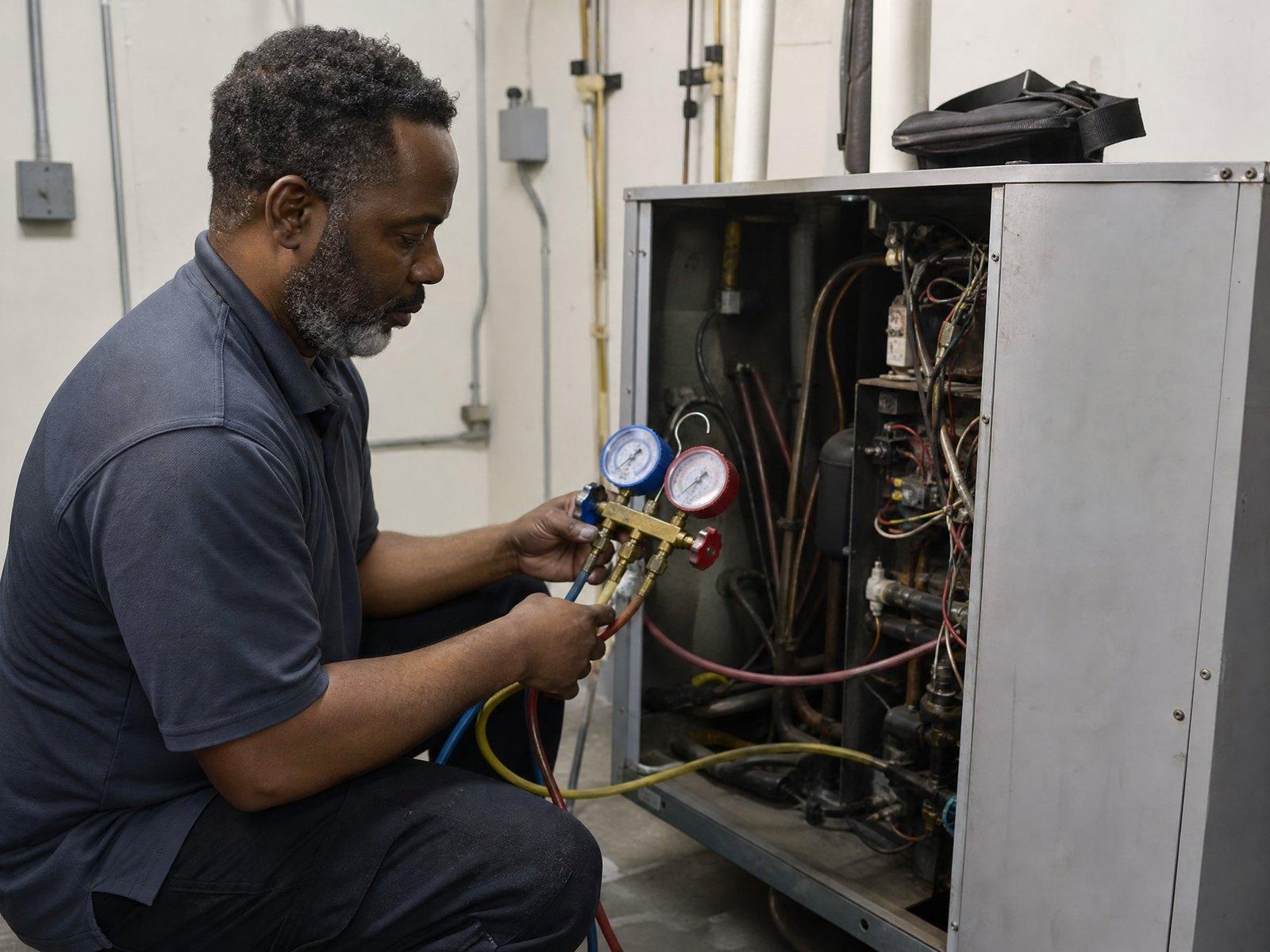
Signs a rooftop unit is due for replacement
A unit that is fifteen to twenty years old with repeated service calls
A failed compressor or cracked heat exchanger on an older model
Tenant complaints about hot or cold spots that service did not fix
Rust through the cabinet, base rails or curb
High energy use compared with similar units on the same roof
A refrigerant that is being phased out and getting harder to buy
How the work goes, step by step
Survey the roof
Each unit is checked: tonnage, age, curb condition, gas and power connections.
Plan the scope
The scope sets tonnage, curb work, controls and the crane date, with options for efficiency levels.
Order and schedule
Equipment is ordered, permits are filed and the lift is booked around tenant and street constraints.
Lift and set
The old unit is disconnected and lifted off, the new unit is set on the curb and secured.
Connect and commission
Gas, power, ducts and controls are reconnected, and the unit is started and tested.
What changes the price
- Tonnage and efficiency
- Cost rises with capacity, and higher-efficiency models cost more up front.
- Curb adapter or new curb
- A new unit with a different footprint needs an adapter, and a rotted curb needs rebuilding.
- Crane size and access
- Tall buildings, narrow streets and heavy units mean a larger crane and traffic control.
- Economizer and ventilation
- Code-required fresh air and economizer controls affect the unit and the controls.
- Working hours
- After-hours or weekend work to avoid disturbing tenants costs more than daytime work.
- Number of units together
- Replacing several units in one mobilization spreads crane and project costs.
What a good quote spells out
- The tonnage and ventilation basis, with the model for each unit
- Curb work and roof flashing included or excluded
- The crane size, access plan and traffic control
- The hours of work and the expected downtime for tenants
- Controls integration and the start-up testing
Commercial Rooftop Unit (RTU) Replacement & Service: questions people ask
Should we repair or replace a rooftop unit?
Age, the type of failure and the repair cost against the remaining life decide it. A failed compressor or heat exchanger on a unit near its end of life often points toward replacement.
How long does an RTU replacement take?
The lift and set can be done in a day for a single unit, while ordering the equipment can take weeks. Planning ahead avoids the rush.
Can multiple units be replaced together?
Yes, and it often saves on crane and project costs. A phased plan is possible if the budget has to be spread over time.
What happens to the tenants during the work?
It depends on the unit and the building. The scope should describe the shutdown window and how comfort is handled.
Other Vulcair services
Planning a Replacement? Get a Proper Quote.
Tell us about the building, the current system and what is going wrong. We review every request and follow up in writing with next steps and a free quote.
Request a free quote →